You pick a color, bring home two cans of paint, and halfway through the room you discover you need another. Or you buy five gallons for a small bedroom and store the leftovers for years. Both happen when paint quantity is guessed from floor size instead of measured from the surfaces you plan to paint.
A useful estimate needs just a few things: wall area, openings, number of coats, the paint’s stated coverage, and a reasonable allowance for surface conditions. You can do the math yourself or use the HITU Interior Paint Calculator and spend more time choosing the finish.
First, decide what you are painting
Are you painting four walls? Only an accent wall? The ceiling too? Are baseboards, doors, and window trim included? These may require different products and separate measurements. Make a short scope list before entering numbers into a calculator.
If you’re planning to repair old picture holes or scuffs, do that before the paint phase. Our small drywall repair guide explains why patches must be prepared and primed correctly.
Would you rather skip measuring and supplies? Request an interior painting or repair estimate with the number of rooms, photos, and whether ceilings or trim are included.
Step 1: Measure the walls, not just the floor
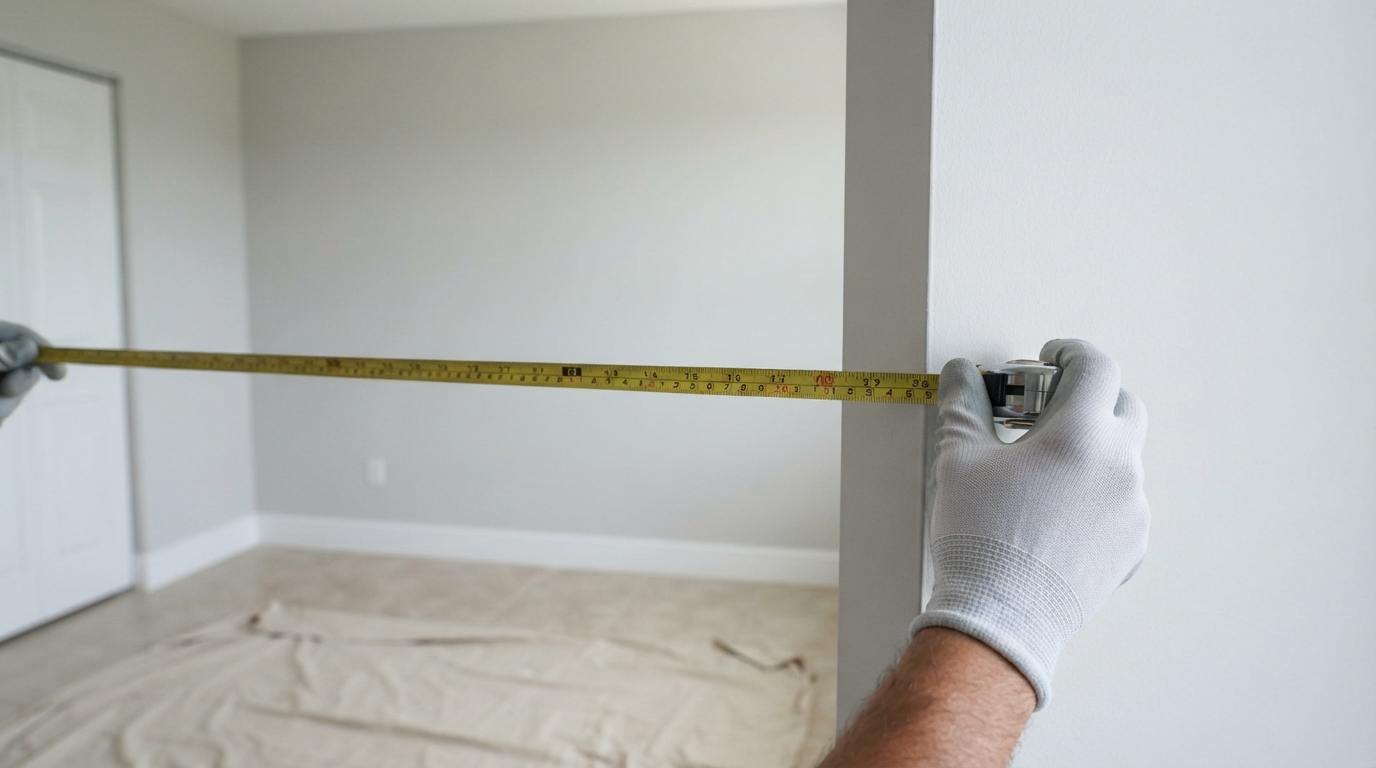
Take the length of each wall and its height. Multiply each length by the height, then add the wall areas. For a simple rectangular room with uniformly tall walls, you can calculate wall area using the room’s perimeter multiplied by wall height.
For example, imagine a room that is 12 feet long, 10 feet wide, and 8 feet high:
- Perimeter: 12 + 10 + 12 + 10 = 44 feet.
- Gross wall area: 44 × 8 = 352 square feet.
That is the starting point, not necessarily the amount you’ll paint. Don’t use the floor area of 120 square feet as though it were wall area. Vaulted ceilings, stairwells, alcoves, and built-ins need separate measurements.
Step 2: Decide what to do with doors and windows
You may subtract large unpainted openings from the total wall area. For smaller projects, some homeowners leave a modest buffer rather than subtract every narrow opening, because actual application also includes waste and touch-ups. The important thing is consistency: do not subtract an opening and then add its area back without a reason.
If the door itself will be painted, calculate it separately. The same applies to trim or a different ceiling paint.
Step 3: Multiply by coats
A wall that changes color significantly, has patchy repairs, or is highly textured may need more preparation or additional coats. The label’s coverage is a guide, not a guarantee for every wall. For our 352-square-foot example:
- One full coat over gross wall area = 352 square feet of coverage.
- Two full coats = 704 square feet of total coat coverage.
If you subtract a 15-square-foot unpainted window and a 21-square-foot unpainted door, the net wall area becomes 316 square feet, or 632 square feet for two coats. These are illustrative measurements, not product-specific recommendations.
Step 4: Use the actual paint label to estimate gallons
If a specific product states 350 square feet per gallon under the conditions described on its label, dividing the illustrative 632 square feet by 350 gives about 1.81 gallons before project-specific waste or additional coats. Purchase formats vary, so plan with the product’s real specifications and local availability.
Formula:
Estimated gallons = (paintable area × number of coats) ÷ stated coverage per gallon
This formula does not automatically cover primer, heavily textured walls, substantial waste, or a different product for trim and ceilings. A paint calculator helps organize the inputs but should not replace the product label.
Step 5: Add preparation, primer, and touch-up planning
An accurate gallon estimate is only one part of a successful project. Before painting, identify loose paint, nail holes, damaged caulk, stained areas, and the need to protect floors and furniture. Some repairs need spot primer. A major color change or exposed substrate may need another plan entirely.
Even a fresh wall can look inconsistent if you paint one small spot with a different sheen. Compare the existing finish and decide whether you need to paint the whole wall to its corners.
Which calculator should you use?
Use the Interior Paint Calculator for walls inside the home. Use our Exterior Paint Calculator for outdoor wall areas and the different considerations of that job. If you’re choosing application tools, read Paint Sprayer vs. Roller.
Have the measurements but don’t want to paint yourself? Send the room dimensions and photos to HITU. We’ll review suitable preparation and finish work and clarify the scope.